

Sending money or making a payment to someone within your own country is typically fast and free. And within Europe, SEPA and in particular SEPA instant provide a similar convenient, transparent, and fast way to make payments in euro to over 40 countries – providing the experience of a single payments area.
But for decades, sending money internationally has meant accepting a small ritual of uncertainty. You go to your bank app, create a transfer, put your beneficiary’s details, the amount and currency to be paid, select who pays the costs using some funky OUR/SHA/BEN codes, and finally press “Send”. Often, you did not see the FX rate up front, how much the costs would be, nor when the money would get there. And good luck if you did that on a Saturday – your payment would not even leave your bank until Monday afternoon or even Tuesday. Then your friend on the other side would complain, why they didn’t get the money when you said you sent it and why they didn’t get the instructed amount. And you saw your bank’s fees debited from your account only afterwards.
That is now changing. Over the past year, Swift and a growing coalition of its member banks have been rolling out a new Payments Scheme for cross-border retail transfers. Not a new network, but a rulebook that finally puts enforceable commitments behind the promises banks have always made about speed, cost and transparency. Banks around the world have gone live and dozens more committed to follow through this year and into 2027. For any bank still running its cross-border retail book on legacy correspondent arrangements, this is the moment to understand what is changing, why, and what it will take to keep up.
Why now
The trigger is not mysterious: correspondent banking’s retail experience has become a competitive liability. With the advent of more agile providers such as Wise and now even stablecoin solutions, traditional banks have seen their cross-border payments flows significantly reduced, along with their deposits and related FX revenues.
And for Swift, that meant less international transaction volumes, along with the constant correspondent banking “bashing” since Swift is largely associated with this global banking practice.
Swift cannot solve this on its own, however. Swift’s data shows that its network – the international part of the journey between two bank accounts for less than 20% of the total end-to-end time. The remaining 80% disappears into what the industry calls the “last mile”: the domestic leg after a payment reaches the beneficiary’s country, where it runs into local clearing cut-off times and inconsistent market practices – adding time and cost. Along the way, intermediary banks may deduct “lifting” fees, shrinking the amount that actually reaches the recipient.
The numbers back up the frustration. A typical $200 remittance can still cost around $12 – roughly 6% – even closer to 10% in some markets. The World Bank’s most recent Remittance Prices Worldwide data puts the global average at 6.36% (remittanceprices.worldbank.org), well above the UN’s target of 3% by 2030. Delivery timelines remain equally unpredictable: transfers may take one to five business days with no guaranteed window – a big contrast to the instant experience you got from that SEPA payment you did the day before.
Regulators have taken notice. The G20’s Roadmap for Enhancing Cross-Border Payments, coordinated through the Financial Stability Board, sets four targets for the end of 2027: 75% of payments available to the recipient within one hour (the rest within a business day); a global average cost capped at 1%, with no corridor above 3%; upfront disclosure of cost, FX rate and delivery time; and at least one electronic option in every corridor.
On its own network, Swift already beats the speed target, as 75% of Swift payments reach the beneficiary bank within ten minutes, comfortably inside the G20’s one-hour window. But that statistic only measures the messaging leg, between Swift member banks, and does not include that “last mile” to the final beneficiary.
Competitive pressure adds urgency. Visa Direct and Mastercard Move offer real-time payouts to cards, accounts and wallets that bypass the correspondent chain. And both are expanding: Visa’s tie-up with UnionPay for mainland China, Mastercard’s cross-currency pilot with the ECB’s TIPS platform, and both networks now piloting stablecoin settlement legs. Stablecoin and crypto rails market themselves explicitly on the contrast with legacy correspondent banking, even if the real-world payment volume remains modest. Still, Swift and its member banks must step up their game to keep (regain?) this business – hence the need for a new Payment Scheme.
What the scheme is, how it works, and what banks need to do
Swift’s new Payments Scheme is best understood as a promise, formalised.
It does not replace Swift’s messaging network nor ask banks to rebuild their correspondent relationships from scratch. Instead, it provides a rulebook on top of the existing infrastructure, turning service expectations into enforceable commitments – specifically for retail, consumer-originated cross-border payments, the segment where the last-mile problem is most acutely felt.
Two roles sit at the centre of the scheme.
- The Debtor Agent is the sending customer’s bank, and it owns the experience at the point of initiation: validating payment and beneficiary data upfront, and disclosing the fees, the FX rate and the expected delivery time before the customer confirms the transfer. No surprises after the money has already left.
- The Gateway Intermediary is the bank on the receiving side that brings the payment into the destination market, and it owns the last mile: settling through the domestic instant-payment system or a book transfer wherever the local infrastructure allows, passing on the full value with no deductions, and confirming credit back through the GPI tracking chain so the sending side – and the customer – can see the payment land in real time.
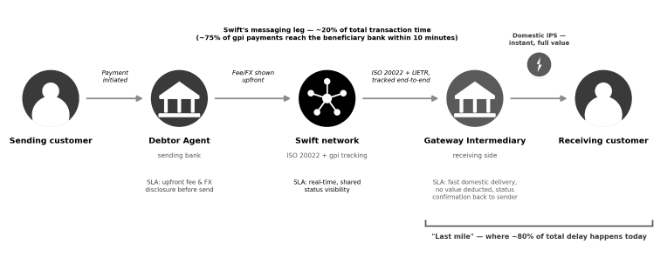
Payment flow and per-actor SLA commitments under the Swift Payments Scheme
Underneath both roles, Swift’s own network carries the ISO 20022 message and a unique end-to-end transaction reference throughout the journey, giving both banks, and ultimately the customer, shared visibility rather than a black box.
In short, here’s what changes:
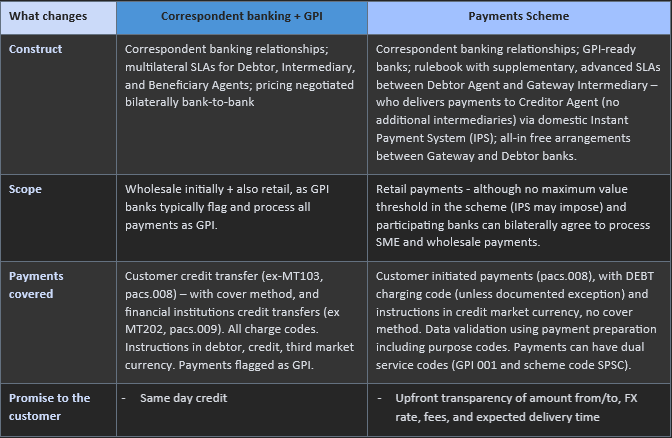
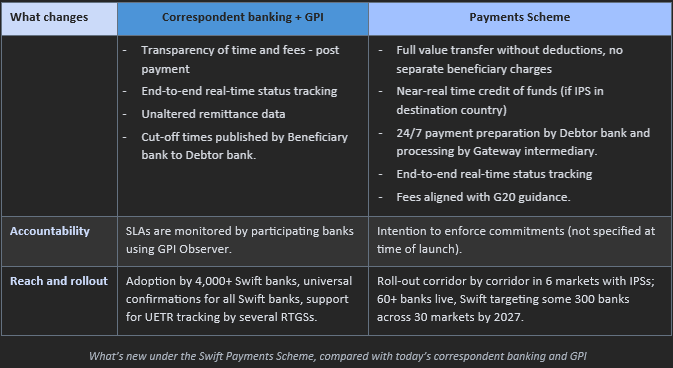
Who is live
Swift announced the scheme in September 2025 with an early coalition of more than thirty banks across seventeen countries, reached a minimum viable product in the first half of 2026, and began processing live transactions from June 2026. Since then, the rollout has proceeded market by market rather than through a single global switch-on, with individual banks confirming their own go-live dates.
One of the first live transactions ran between City Bank in Bangladesh and HDFC Bank in India in late June 2026, settling in under two minutes. Several additional banks have announced their go-live since and some sixty banks are now actively processing payments under this new scheme across as many corridors connecting seventeen countries, and more committed to implement before the end of 2026. Swift’s stated ambition is to reach around three hundred banks across thirty markets by 2027 – a substantial scale-up from today’s base.
The challenges that remain
None of this makes the last-mile problem disappear overnight, however. The scheme is voluntary, and its enforcement mechanism – how Swift will actually hold banks to their commitments over time – was still being defined as the framework launched.
There are structural limits, too. The last mile still depends on domestic infrastructure and regulation that Swift cannot unilaterally change. Currency controls, in particular, will keep some corridors slower than others regardless of what the scheme requires.
Integration into front-office and customer-facing systems is arguably the more decisive variable: a bank can meet every scheme commitment on the back-end and still fail its customers if that improved experience never appears in the mobile app or the online banking portal they actually use.
And scale is still modest against the scheme’s ambition – seventy banks is meaningful momentum, but it is a fraction of Swift’s eleven thousand connected institutions, and critics have already argued that this is an upgrade to existing correspondent banking rather than a fundamental redesign of it.
Not the only option on the table
Banks weighing their response should also recognise that the scheme is not the only route to a better cross-border experience, and for many institutions the real decision is not whether to join it, but how it fits alongside other options.
Global transaction banks with deep correspondent networks can offer much of the same experience today through their own proprietary services. Card networks offer real-time payouts to cards, accounts and wallets that can outperform correspondent banking on speed for retail remittance use cases, at the cost of running on infrastructure a bank does not control. Agile non-bank payment service providers, from Wise Platform to a growing list of wallet-focused aggregators, promise fast integration and transparent pricing, in exchange for a new commercial dependency outside the bank-governed Swift cooperative. And central banks are exploring their own answers, linking domestic instant-payment systems directly to one another, while stablecoin and tokenised-deposit rails continue to attract investment from banks and card networks alike as a longer-term settlement layer.
None of these alternatives is mutually exclusive with Swift’s new scheme, and the pattern emerging across the market is convergence rather than a clean choice: banks that are building scheme compliance are, in several cases, the same banks partnering with card networks, correspondent banks and fintech platforms for other corridors and use cases. The realistic strategy for most institutions will be a considered mix, not a single bet.
What this means for your bank
The starting point for any bank is a clear-eyed view of its own exposure: how large is your retail cross-border payments business, and how much of it is genuinely at risk from customers who are already using faster, more transparent alternatives. From there, the decision is less about whether to act than about sequencing – whether the Swift scheme, a card-network partnership, a fintech platform, or some combination best fits your client base, your existing infrastructure, and your appetite for change.
Joining the scheme itself is not a light lift for a bank. It touches ISO 20022 data quality, pre-validation and tracking capabilities, 24/7 processing capabilities, front-office integration, and domestic settlement and correspondent fee arrangements for gateway intermediary banks.
On the other hand, the rewards may be compelling: protecting your existing business whilst staying competitive and relevant in an evolving payments landscape, potentially growing your cross-border payments volumes building on the scheme’s strong customer experience differentiation, and genuinely keeping customers happy by enabling a more transparent, faster and cost-efficient international payments.
Whatever a bank concludes, the direction of travel is clear. Customers are now used to instant and transparent payments in their own country and are no longer willing to accept a materially worse experience simply because their money is crossing a border. Swift’s new Payments Scheme is one serious answer to that expectation.
Paylume helps banks work through exactly this decision – sizing the opportunity, choosing between or combining the scheme and its alternatives, and building the roadmap to get there. If you want to figure out what this means for your business – let’s talk.