

Digital assets continue to be a “hot topic” in the financial industry.
I can’t help thinking that is both driven by real progress – from new stablecoin licences to live tokenised deposit deployments – as well as continued FOMO (fear of missing out) by banks that are not quite there yet.
Also at Sibos – the yearly gathering of Swift and its community of banks – held in Miami at the end of September this year, digital assets were one of the key themes, supported not only with an impressive set of dedicated sessions but also a plethora of blockchain technology exhibitors that I previously only saw at Money20/20.
And it’s hard to keep up with all the LinkedIn posts and newsletters in my email inbox, touting new announcements on retail and wholesale CBDCs, stablecoins, tokenised deposits, tokenised bonds and funds, and crypto services. Here are a few I’d highlight, with immediate relevance for banks in Europe:
- The ECB launched Pontes on 21 September, so tokenised assets can now settle in central bank money through TARGET Services,
- Swift showcased its ledger at Sibos, an interoperability play to enable banks’ tokenised deposit solutions to work together to provide 24/7 payments, with 17 banks sending live cross-border transactions,
- Qivalis, the euro stablecoin venture of 37 banks, was authorised as an electronic money institution by the Dutch central bank on 14 October, and expected to issue soon.
Already in July of this year, Paylume’s white paper “Digital Assets – Cutting through the noise to build your bank’s strategy” suggested that, for banks, the challenge was no longer whether these new initiatives deserve attention, but to develop a strategy that fits the bank’s own business model, client segments, and long-term strategy.
That’s all good but can we make this more practical? What are the use cases these initiatives can enable, providing real value, and leading to new revenues for banks?
Rather than a catalogue with a long dry list, I selected five use cases for you, where interesting things are happening today with banks offering real life services, combined with some which are under exploration but promise exciting future prospects. Three are for corporates, one for retail clients, and one for financial institutions:
- Intra-company cash management using tokenised deposits
- Cross-border payments using a stablecoin
- Agent-initiated payments using tokenised deposits
- Retail crypto investment services, inside the bank’s own channel
- Tokenised bonds settled in central bank money for institutional clients
I also give some names of actual banks that provide these services, purely as examples.
Intra-company cash management using tokenised deposits
Imagine a large corporate with a centralised treasury, managing cash across different legal entities in multiple countries. The movements between those accounts are constrained by the operating hours of the banks that operate the accounts where that money sits. And when money needs to move from one account to another on a weekend, that could be problematic, if the bank is closed. Those cut-offs and operating hours dictate when a sweep can run. As a result, maybe too much cash is sitting in local buffers, because moving it around is slow, and those buffers are expensive.
Enter tokenised deposits. They are a claim on your bank, recorded on a blockchain rather than in the bank’s ledger alone. It is not new money. It is the same euro on your balance sheet, in a form that can move on a programmable network. Still insured, still supervised, still on-balance-sheet.
But now, there’s a better “plumbing”. These tokenised deposits can be moved around the clock, on a blockchain ledger that runs 24/7. Transfers settle in seconds between entities in different countries, so cash moved at three PM on a Sunday is ready to use on Monday morning. Maybe even more interesting than the speed is the programmability: payment and condition can travel in one instruction. Funds can be moved from an account with surplus to an account that needs funding based on certain thresholds, or in and out of tokenised money market funds to earn overnight interest. That’s not just faster money movements. That’s a better product.
I think this use case will interest many corporate treasurers. And it’s already real. JPMorgan’s Kinexys is reported to have processed over $4 trillion by mid-2026, averaging more than $7 billion a day across eight currencies including euro and sterling.
For a bank, this is also an interesting proposition. A treasurer who runs liquidity on your rails keeps balances with you rather than spreading them. This is a deposit-gathering product dressed as a technology project, and the net interest income on retained operational balances is the biggest number in the business case. Then there’s the per-transfer pricing on round-the-clock movements, at a premium for conditional payments, which are worth more to the client because they replace manual decisions and reconciliation. And the ability to offer programmable cash may be a reason to consolidate cash management with one bank rather than three. The mandate carries FX, trade finance, lending, etc. with it.
Sounds appealing but this use case only really delivers its full value when it can be used across multiple banks. And that requires interoperability between banks, something the Swift ledger mentioned earlier is aiming at providing.
Cross-border payments using a stablecoin
Picture a mid-sized European manufacturer that needs to pay a supplier in Singapore. The payment goes from a Belgian bank to a bank in Singapore – using correspondent banking, and could involve a series of steps, via intermediary banks. Each hop may add some time, each intermediary may take a fee, and the FX could happen in the beginning, somewhere in the middle, or at the beneficiary side, at a spread the payer cannot see.
Stablecoins can offer an alternative. A stablecoin is privately issued digital money that holds its value against a reference currency, backed one-for-one by cash, bank deposits and short-term government debt. Under MiCA, a euro stablecoin issued in the EU is a regulated e-money token: segregated reserve, redemption at par, authorised and supervised issuer. That wrapper is what makes it a banking product rather than a crypto product. Circle’s EURC is the largest at roughly $0.5bn, about 60% of the euro market, with Société Générale’s EURCV second. Qivalis, referenced above, is expected to issue its euro-denominated stablecoin before the end of this year.
Such stablecoin payments settle in minutes. Broadly speaking two models exist: a “sandwich” where fiat is converted to stablecoin and then back to fiat or “toast” where a stablecoin is converted to fiat. It still requires parties to access a DLT network supporting the stablecoin but the chain of intermediaries collapses. For non-US payments denominated in USD, which can involve several banks, and hence time and cost, this could be particularly interesting.
For the banks offering such stablecoins, that can present a revenue proposition. As issuer, or shareholder in an issuing venture, there is the reserve income. As distributor, banks can provide the “ramps”, the conversion between euro deposits and euro stablecoin, in and out – that is a fee event, as is the foreign exchange when the corridor is cross-currency – still the biggest margin pool in cross-border payments. And as service provider, those banks providing the payments services keep the deposits, the client holdings, perform the screening and treasury services for businesses holding working capital in token form.
Also here, whilst being used in certain corridors, I’d like to point out a few things. First the stablecoin needs to exist, be licensed, and find enough support to be listed on DLT networks that have enough participants to cover the payment from A to B. Also, the fees and FX may become more transparent if done up front but they do not disappear. So, the overall cost/benefit picture still needs to be made.
Agent-initiated payments using tokenised deposits
Another use case I’d like to share is more exploratory yet quite exciting: combining AI and digital assets to provide agentic payments.
On 9 October, Ant Digital Technologies and HSBC completed a technical test. An AI agent discovered a digital service on Ant’s Anvita Flow network, invoked it, paid for it with a micropayment, settled in real time using HSBC’s Tokenised Deposit Service.
The tokenised deposits give the AI agent money that moves 24/7, programmable, in amounts that traditional or card rails cannot easily carry – and it is still bank money, still on-balance-sheet, still inside the bank’s risk perimeter.
For banks there is a real proposition. Per-transaction revenue at these sizes is fractions of a cent, so the business case is volume, not unit margin. The defensible product is the control layer: mandate issuance, scope, limits, revocation and real-time scoring. The deposits stay, because an agent funded from a tokenised balance keeps that balance with you. Know Your Agent is an identity business, banks already run that for people. And someone has to keep the signed mandate and the action log, because that is now the evidence in any dispute.
Still, lots of caveats and things to resolve for this use case to fly, like fraud, AML, and determining who is responsible for the agent’s actions and potential mistakes. And for all these interactions to happen seamlessly in an automated fashion, standards are needed: check out x402 for instance, which revives the HTTP status 402 for per-request machine payments.
Retail crypto investment services, inside the bank’s own channel
Here’s another interesting use case: crypto investments for your retail clients.
Since February this year, KBC’s retail clients can buy and sell Bitcoin and Ether inside Bolero, its investment platform. The bank is not putting crypto on its balance sheet. It is doing for crypto-assets what it already does for equities: execution, custody, reporting and tax statements, inside a regulated wrapper. And the model is closed: no transfers in, no transfers out. Coins bought in Bolero stay in Bolero until they are sold.
It’s the first Belgian bank to do so, with a CASP notification under MiCA. Under Article 60, an authorised credit institution does not need a separate CASP licence – it notifies its national authority 40 working days before it starts. The effect shows in the register. By mid-September 2026 nearly 80 banks were on ESMA’s MiCA list, roughly double the number in June, taking banks from about 17% to 23% of all registered providers. DZ Bank took its retail approval in January, Raiffeisen is rolling out across eleven markets, and Deutsche Bank is building custody.
For a bank, the economics are familiar. There is the spread or commission on each trade. There is a custody fee, which is annuity revenue rather than transaction revenue. There are the balances: cash that would have left for an exchange now sits in the client’s account between trades and doesn’t leave the bank. There is defence of the customer relationship, which matters more than the crypto line itself – keeping the client with you instead of them opening a second, non-bank investment app and later on move everything to it. And there is visibility. A holding the bank can see is a holding the bank can advise on, report on and eventually cross-sell against.
The closed loop is both the control and the ceiling for the bank: it is what makes the risk committee comfortable, and it is also why the bank cannot win the client who already holds coins elsewhere or wants to do self-custody.
Tokenised bonds settled in central bank money for institutional clients
On 26 October, the European Stability Mechanism priced a €1 billion bond at 3.375%, maturing 8 April 2030. To an investor, an ordinary benchmark deal.
What is not ordinary is that it never existed on paper, and that the cash paying for it settled in central bank money. European supranationals have issued digital bonds before – the EIB since 2021 – but this is the first to settle on Pontes.
Let’s start with the asset. A tokenised bond is an ordinary bond whose record of ownership sits on a shared ledger rather than in a chain of custodians and registrars. Same issuer, same coupon, same legal claim. What changes is who keeps the record, and how many copies of it exist. Here, Clearstream created and manages the bond on its D7 DLT platform, acting as market DLT operator.
Then the cash leg, which is the part that was missing until now. You could tokenise a bond perfectly well before Pontes, but the euros paying for it still arrived separately, through a conventional payment, which reintroduced the delay and the exposure you were trying to remove. The workaround was to settle the cash leg in commercial bank money. Pontes removes the need for it: delivery versus payment happens on D7, while the cash leg settles in central bank money, directly in T2.
The benefits are real. Delivery and payment happen together, so the exposure in the settlement window does not get managed, it stops existing, and the collateral posted against it is freed. The cash leg is central bank money, which carries no credit risk by definition. And the bond is not trapped on the new rail: it can move to traditional infrastructure and settle through T2S, which is what makes it investable for a buyer with no interest in any of this.
For banks, there is the arranging and advisory mandate, which pays what a conventional benchmark pays. There is distribution, where fractionalisation reaches buyers that minimum denominations currently exclude. There is digital custody, the genuinely new line, since holding tokenised assets for clients needs key management, segregation and permissions that most asset managers and corporates will not build – and custody is annuity revenue. There is being the settlement provider that smaller institutions plug into. And there is the balance sheet: instruments that settle instantly and mobilise intraday need smaller buffers.
Whilst real, this use case needs to scale further. One €1 billion deal is not a market, and secondary liquidity remains the open question: a bond trading on one platform with a handful of participants will be priced for that until the participant list grows. Pontes itself is early, opening with a core set of services and thirteen market participants, with automatic defunding only at end of day for now and full implementation expected by 2028. Much of what makes this deal attractive – the listing, the collateral eligibility – is expected rather than done.
To summarise:
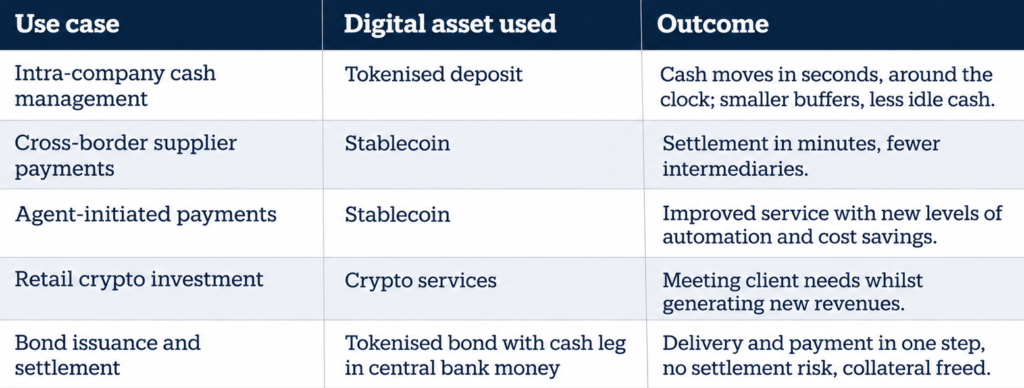
Whilst your IT division “could” develop any of the required technical capabilities, the more interesting question is if your bank “should” offer any of these services. This question is what makes digital assets so exciting on one hand and so puzzling to many bankers at the same time: the potential is real but how can I apply this to “my bank”.
The DLT networks are there and becoming more interconnected and interoperable. Banks can buy the infrastructure, from a list of vendors who can now show testimonials. The stablecoins too are available from a growing number of providers.
What has not been answered, by most banks, is which of these use cases belong in your franchise, in what order, and who will own the P&L, A bank with a corporate cash management business has a different first move from one with a predominant retail client base. This is worth forming a view on, before your next budget cycle.
And don’t forget to bring in your risk and compliance teams, from the beginning. I’ll keep that for a future article!