
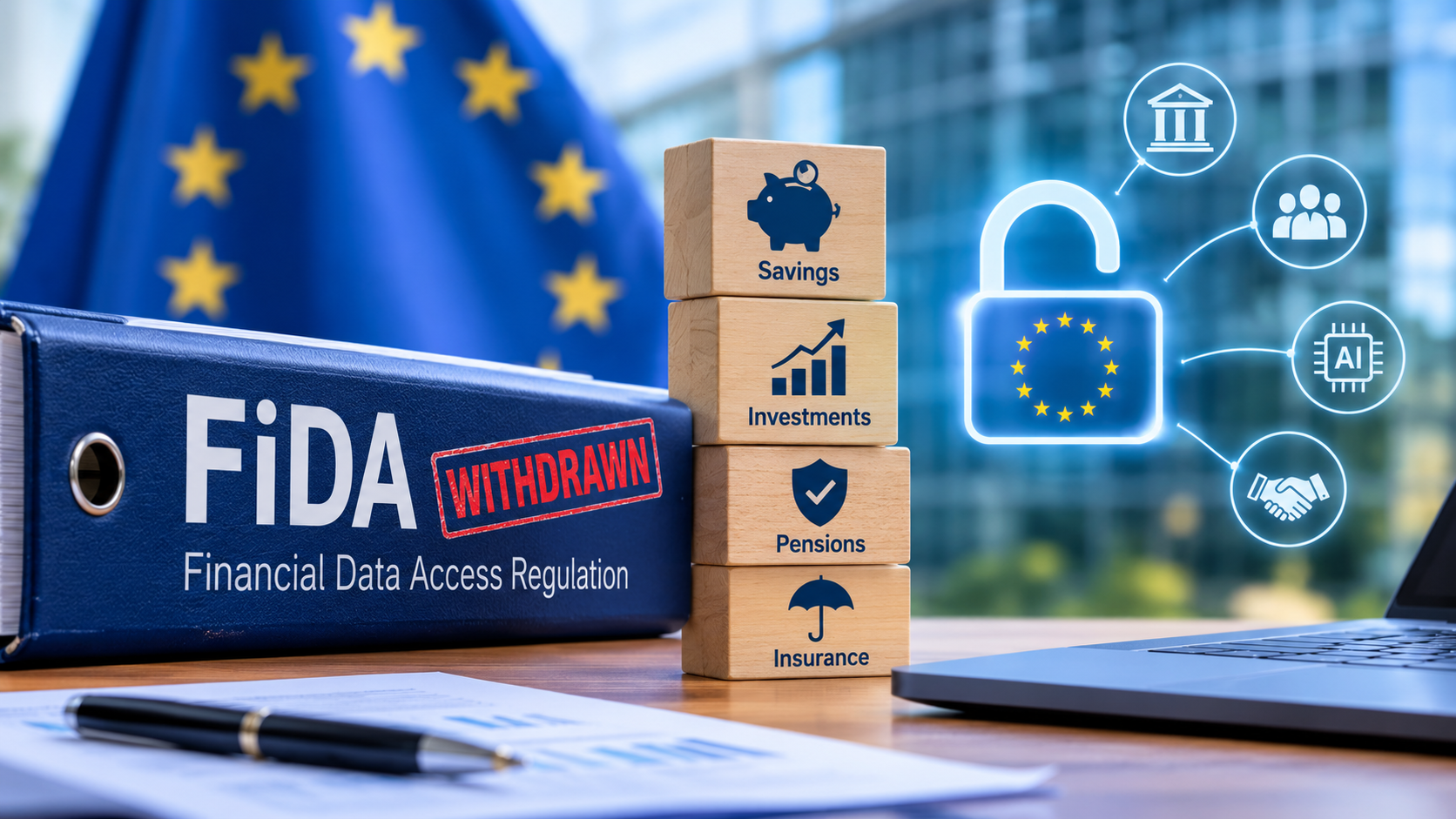
On 4 November 2026, the European Commission placed the Financial Data Access Regulation (FiDA) on the withdrawal list of its 2027 work programme, ending its plan to mandate open finance across the EU. Proposed in June 2023, the regulation would have extended open banking to savings, investments, pensions and insurance and would have been a monumental step towards a true open finance ecosystem in Europe.
Whilst many banks and insurers have welcomed the decision (even some central banks), withdrawing FiDA does not stop unregulated open finance and third parties from accessing customers’ financial data. Instead, it removes the framework that would have given data holders a way to control, price and audit that access. All this coming at a time where AI agents are starting to push into the financial realm.
Things to remember
- FiDA is on the withdrawal list but not yet formally withdrawn, and no successor has been named.
- The only EU-wide data access right stays limited to payment accounts, under a Payment Services Regulation that won’t apply before late 2028.
- Outside payments, screen scraping and credential sharing remain legal by default.
- Europe still has no single open banking API standard, and now no driver to create one beyond payments.
- AI agents will increase demand for this data, and while card networks have rules for agents, open finance outside payments does not.
- Finance now lags other sectors in the EU’s data spaces strategy.
What really happened to FiDA
According to Annex III of the 2027 work programme, the proposal had sat with Parliament and Council for over three years, with no trilogue since June 2025 and no Council majority in sight.
Withdrawal is not yet formal and the Commission plans to act within six months, and Parliament and Council can still give their views. The Commission also has not abandoned the policy goal, as recently as April 2026, a Commission non-paper called data access a competitiveness factor and pushed for a deal.
When
- 4 Nov 2026
- Apr 2026
- Jun 2025
- Feb 2025
- Jun 2023
What happened
- FiDA listed for withdrawal; no successor named
- Commission non-paper still urging agreement
- last trilogue meeting
- leaked draft work programme first flags withdrawal
- FiDA proposed alongside PSD3 and the PSR
Incumbents argued that the cost of standardised interfaces and permission dashboards outweighed customer demand, and that Big Tech would be the main winner. Germany’s insurance association GDV welcomed the withdrawal, saying the money is better spent on AI and cybersecurity, and that the decision also reflects the Commission’s wider simplification agenda.
For me, this is a vast underestimation of what really needs to happen. The growing use of AI agents are operating under a framework they were not designed for.
Open finance after FiDA
Without FiDA, the only EU-wide legal right to share financial data with a third party is the payment account right, moving from PSD2 into the Payment Services Regulation. Savings, investments, pensions, insurance and credit fall back on GDPR portability, contracts and voluntary schemes.
The PSR improves on PSD2 but is not yet law. The final texts were published in April 2026; Parliament’s plenary is pencilled in for 14 December 2026, and the PSR applies 21 months after entry into force. On that timetable, it is unlikely to apply before late 2028. Once it applies, banks must meet enforceable interface quality requirements, may not obstruct TPP access, and must offer customers permission dashboards.
Beyond payments, open finance will now develop through commercial arrangements. The EPC’s SPAA scheme is the most developed model, with premium APIs and a default access fee, but it covers payment accounts only and currently no banks are participating. There is no pan-European equivalent for investment, pension or insurance data, so access is likely to vary by sector and by member state, with data holders deciding what to make available, to whom and at what price. For competitiveness and pan-European innovation both at a bank and TPP level this creates significant fragmentation and barriers to entry.
Screen scraping continues outside payments
FiDA would have given firms a regulated alternative to screen scraping for non-payment data. Without it, the legal position depends on the type of data. For payment accounts, TPPs must identify themselves and use the bank’s dedicated interface, and the PSR tightens this further. For everything else, accessing data with shared credentials, reverse-engineered apps or rendered web pages isn’t prohibited. It is governed only by GDPR, contract terms and the data holder’s own controls, which is the situation FiDA was intended to address.
The risks are well known. Customers share their full login details, including the authentication factors SCA is meant to protect; liability for losses is unclear; and data quality depends on website layouts that can change without notice. As data holders cannot distinguish a legitimate aggregator from an attacker, they tend to block both.
For banks and insurers, this means that withdrawing FiDA does not reduce third-party access to their customers’ data, it removes the mechanism that would have let them manage it.
The lack of common standards
PSD2 required banks to provide access but did not set a single API standard, and the market has dealt with the consequences since 2019. The Berlin Group’s NextGenPSD2 became the reference point, but STET, PolishAPI and several national variations mean two compliant banks can still expose very different interfaces. The EBA recommended a single common API standard back in 2022. The PSR raised performance requirements instead and left the specification to the market.
FiDA was the only proposal that would have required common standards beyond payments. Without it, there is:
- No mandated data model for investment, pension or insurance data.
- No common consent or permission dashboard specification outside payment accounts.
- No identity and trust framework for non-PSD2 data users.
- No body with a mandate to converge competing specifications.
Several useful components already exist: the Berlin Group publishes an openFinance framework, ISO 20022 offers a mature financial data dictionary, and SPAA shows a workable governance and remuneration model. But we are missing any requirement to bring them together.
What this means for AI agents
FiDA’s withdrawal may have its largest effect on a use case it was not designed for – AI agents that compare mortgages, rebalance portfolios or look for cheaper insurance renewals, and which need exactly the cross-sector data FiDA would have standardised. Without a regulated channel, the simplest option is for customers to give agents their login details, or for browser-based agents to log in on their behalf, which is in effect screen scraping by another means.
Card networks are furthest ahead. Visa’s rules have defined an ‘Agentic Transaction’ since October 2025, require agents to use network tokens rather than card numbers, and make the cardholder answerable for the agent. Mastercard Agent Pay registers agents and issues agentic tokens; Stripe issues scoped, time-limited payment tokens.
The agreed PSR text does not mention AI agents, so how its SCA rules apply to an agent holding a token is open to interpretation. In the UK, HM Treasury has openly asked whether authentication, consent and liability rules need updating for agentic payments.
How an agent gets access
Delegation model
Agent identified?
Liability
Card payments
Network tokens, scoped credentials, signed requests
Yes, via scheme regestries
Allocated by scheme rules
Payment accounts (PSD2/PSR)
TPP consent and SCA
Only via a licensed TPP
Defined for TPPs, untested for agents
Savings, investments, pensions, insurance
Shared credentials or browser automation
No
Effectively none
The last row is where an open finance regulation matters, as credential sharing defeats SCA by design, leaves no record of what the customer actually authorised, and makes agents hard to distinguish from attackers. Data holders are likely to respond by blocking automated traffic.
A better approach is to bring agents within existing regulated channels e.g. agents acting through licensed AISPs and PISPs, with consents that capture the scope and duration of a delegated mandate. This approach does not depend on FiDA, although the regulation would have made it easier to implement.
Finance and the EU data strategy
FiDA was also part of the EU’s wider data policy. The 2020 European strategy for data named finance as one of the original Common European Data Spaces, and FiDA was meant to give it legal substance.
Other sectors are further ahead. Health has the European Health Data Space regulation, and energy and mobility have funded deployment projects, while the Commission’s own rollout page lists a single item for finance, the Digital Finance Platform and its Data Hub.
The Commission’s priorities have also shifted since 2020. Its Data Union Strategy of November 2025 focuses on unlocking data for AI, scaling existing data spaces and simplifying the rulebook. This does actually mark a move away from new sector-specific access rules, and FiDA’s withdrawal is consistent with it.
Financial data access now depends on three general instruments: GDPR portability; the Data Act; and the EU Digital Identity Wallet and proposed European Business Wallet.
The risk is that financial data, some of the most valuable personal data in the economy, ends up among the least governed. Demand from AI platforms will continue, and access will either be agreed bilaterally on terms set by the largest data holders or obtained through shared credentials with no agreed terms at all.
US-style approach coming to the EU for open finance?
The US offers a preview of how open finance develops when a regulatory mandate stalls. The CFPB finalised its Section 1033 data access rule in October 2024, but a federal court has since enjoined its enforcement, and the CFPB is rewriting it, including the question of whether banks may charge for data access. In the meantime, the technical and commercial architecture of US open banking is being set through bilateral agreements between large banks and aggregators. JPMorgan announced a commercial agreement with Plaid. Banks are now applying the same approach to AI agents, allowing read-only access through approved open banking connectors while prohibiting credential-based logins and money movement in their terms of use.
For data outside the PSD2 perimeter, FiDA’s withdrawal leaves EU banks in a position much closer to that of their US counterparts. They have no obligation to share this data and are free to refuse access, charge for it or set their own terms for aggregators and agents.
There are still constraints however. Competition law limits discriminatory terms or refusals to supply by dominant firms and makes any coordinated pricing among banks a risk unless it is structured carefully, as SPAA’s default fee is. GDPR portability gives customers a free right to obtain their personal data, although as an export rather than a live connection. And the Data Act’s fair-terms and compensation rules do not apply, because they depend on a sectoral sharing obligation that no longer exists for financial data.
The most likely outcome for non-PSD2 data is therefore a set of bilateral commercial agreements concentrated among the largest banks and aggregators, with smaller institutions and fintechs facing uneven access, alongside bank terms that restrict credential-based agent access and steer agents towards approved channels.
What to do next
With no legislative mandate beyond payment accounts, open finance in Europe will now develop through commercial agreements and voluntary standards. The decisions that banks, fintechs and standards bodies take over the next two years will shape that market well before any future legislation does.
Banks and data holders.
FiDA preparation work should be reviewed rather than written off, since much of it, including consent management, permission dashboards and well-structured APIs, will still be needed for PSR, for handling agent traffic and for banks’ own digital products. Banks will also need a clear policy on AI agents. Offering an approved channel in which agents identify themselves is likely to be easier to price, monitor and defend than attempting to block automated access altogether. For non-PSD2 data, the question is no longer whether to share it but on what commercial terms, and banks that define their premium API offering early will be better placed.
Fintechs, aggregators and agent platforms.
Access to investment, pension and insurance data should now be planned as a commercial relationship with each data holder rather than as a regulatory right, with the costs and negotiating effort that implies. Agent providers should route access through licensed TPP permissions wherever possible and invest in ways for their agents to identify themselves to data holders, as reliance on shared credentials is likely to become harder to sustain. The PSR’s interface quality requirements are important, as the regulated payment account channel will remain the most dependable form of access in Europe for the rest of the decade.
Standards bodies.
In the absence of a regulatory driver, the most useful contribution standards bodies can make is to converge on common specifications rather than develop competing ones. A shared European consent framework and data model for non-payment financial data, built on ISO 20022, could address much of the fragmentation. Delegation to AI agents, covering how a consent expresses an agent’s mandate, how the agent is identified and how the customer revokes it, should be part of that work from the outset.
Looking ahead
There are three main outcomes that could materialise. The first is a narrower FiDA, perhaps limited to investment and pension data, which could return if the Savings and Investments Union agenda, or pressure to give retail investors better tools, revives the case for mandated access; the Commission’s April non-paper shows the underlying policy rationale has not gone away. The second is a market-led model, in which schemes such as SPAA extend gradually beyond payments and a common standard emerges through voluntary adoption. The third is a model shaped mainly by the largest banks and technology platforms, in which access is negotiated bilaterally and AI agent providers, many of them based outside the EU, become the main route by which customers interact with their financial data.
The third outcome is the one FiDA was most concerned with, and it is the most likely if neither regulators nor the industry act. For that reason, the next two years matter. Whichever path Europe takes, legislators will tend to build on the arrangements the market has already put in place, so the organisations that invest now in common standards, consent models and agent identity will have the strongest influence over the rules that eventually follow, and over whether European institutions or global platforms set the terms of open finance in Europe.