

The Swift ledger.
Seems like a big thing, judging from all the recent press; by Swift, its banks, the many LinkedIn posts, even kudos from the DeFi community. Why is that, what value does it bring to end-clients, and how does it actually work? In this article, I’ll cover all these points and try to demystify the excitement.
To better understand the Swift ledger, let’s rewind to Sibos 2026 – Sibos always the occasion for Swift to announce big things. And indeed, Swift’s CEO revealed their plan to build a “ledger”, based on DLT (Distributed Ledger Technology). Some nine months later, they delivered a MVP (Minimal Viable Product) and 17 banks went “live”, sending real payments. Again, massive positive reaction by the industry: “Swift did it, they pulled it off.”
Even to the casual financial industry observer, this astonishment seemed a bit much. Because for Swift, as fintech avant la lettre, having introduced many technologies at scale over its 50 years of existence, putting in a DLT was in itself not that big a deal, right? Neither for its banks, because they have been running live services on various digital assets over DLT networks for several years now. So, what’s going on here?
The core problem: banking hours
Before getting into why the Swift ledger is a real achievement, let me take you back to the very reason it came into being in the first place.
For those that sent cross-border payments from Belgium to Singapore on a Friday afternoon, you knew what was coming – or rather what not. By the time your payment got to Singapore, it was already Saturday, the weekend had arrived, and your money sat in limbo until Monday. Same problem during the week, if it was Tuesday 2PM in Belgium, forget “same-day-value”, the bank in Singapore was already closed.
So, the core problem is quite simple: cross-border money still moves on bank hours – which are 9-to-5 – meaning working hours and weekdays. This is very different from what many of us have become used to for domestic payments: instant and 24/7.
The real magic, and it’s not the technology
Not that Swift is slow, the payment instruction, the “message”, is sent from bank A to bank B in seconds. But the “money” behind it, held at correspondent banking nostro accounts, still waits for cut-off times, local holidays, and the next working day in the right time zone. To circumvent that, this is where the Swift ledger comes in.
So now, to “confirm” that a payment can be executed, the Swift ledger uses banks’ tokenised deposits. As part of the solution, 1) banks deploy a DLT, tokenise client deposits, and “mint” them on that ledger to confirm a payment request. Yes, that’s an achievement, which is not the case for many banks around the world. And 2) the Swift ledger sits “in the middle”, providing the communication to each ledger and thus the interoperability between all participating banks, across many countries. Yes, fantastic, because even at a domestic level, we’ve only seen pilots so far (e.g. GBTD in UK, TCH’s ledger in US). And 3) to make ledger transactions flow smoothly end-to-end, Swift published a rule book, that says exactly what each bank should do at each step, and when the flow breaks – the unhappy path.
But the real magic I would suggest, is that Swift, with this product, “forced” banks to go 24/7, to make their cross-border payments happen around the clock, end-to-end: taking the tokenised deposit confirmation, linking it back to the pending payment, processing it through their core banking applications, and crediting the beneficiary account even at 10 PM or at the weekend. That’s the real customer outcome.
So, the Swift ledger does not make payments using stablecoins, it doesn’t even hold any tokenised deposits, and it does not replace banks. It makes sending payments in fiat currency 24/7. That’s what counts, from the customer’s point of view.
This, even whilst “the money” between banks is not there yet – because the settlement happens later, via existing rails (I’ll explain that later).
And yes, it’s live (with some caveats)
The Swift ledger is not an experiment and neither a pilot that could stop at any point. Banks are sending real payments in production. Following the announcement by Swift that the ledger had been deployed, Standard Chartered and HSBC announced the first live interbank transaction in August. Followed by Mashreq and Citi early October, and ANZ shortly after – more than seventeen banks are live now.
OK, probably the first payments were done in a ‘controlled live situation’, involved some manual operations, not fully supported by end-to-end operating procedures, neither incorporated in client value propositions and service descriptions. And we still need to see more traffic and scale with more banks. But that’s just a matter of time.
Meanwhile, Swift is diligently working to bring a second batch of banks to live.
OK, so here’s how it works – and there’s a surprise bonus
As I briefly explained before, the Swift ledger is best understood as a coordination layer between banks’ ledgers.
Here’s the short version of a ‘ledger payment’, which happens in 4 steps + 2 steps to do the inter-bank settlement:
- Send payment = classic Swift. A payment is sent on behalf of a customer from bank A to bank B as a classic pacs.008, over the usual Swift rails. But that payment is not executed, it’s held by bank B, which asks bank A, via the Swift ledger, to confirm there are sufficient funds.
- Get confirmation = tokenised deposits and DLT. Bank A meanwhile set up its ledger, minted a tokenised deposit on it, and deployed a Swift-provided smart contract that can interact with it. The ‘money’ stays on bank A’s balance sheet, the tokenised deposit does not travel, its claim remains on bank A. The Swift ledger, sitting in the middle, connects to each of the banks’ DLT systems and orchestrates transactions across, asking bank A for that confirmation and informing bank B when it does.
- Credit beneficiary = now 24/7 process. Bank B takes the confirmation, links it back to the pending payment and executes it, meaning, it puts the money in the creditor’s account, in real-time, 24/7.
- Confirm credit = burn tokenised deposit. Upon successful credit, bank B informs via the ledger, bank A, who burns the token.
- Calculate inter-bank position = new function. Swift ledger calculates the banks’ net positions, sends instruction to settle inter-bank position to bank A
(for information, no “obligation”, Swift (ledger) is not FMI). - Settle inter-bank position = existing process. The inter-bank settlement, the actual movement of money between banks, happens via existing RTGS systems and inter-bank payments (e.g., pacs.009).
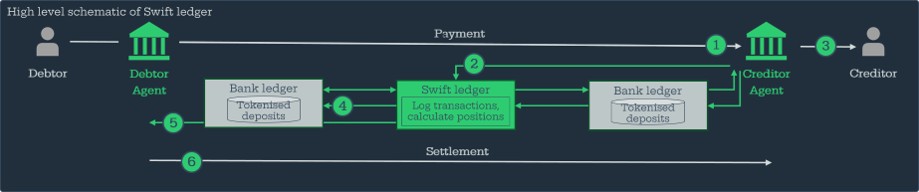
From an end-customer point of view, the credit to the beneficiary is now 24/7, since it can happen overnight and at weekends.
Keeping the payment and the settlement via existing standards, messaging services, bank applications and settlement systems – so ‘off-chain’, was deliberate: it re-uses today’s KYC processes, payment applications, compliance, sanctions screening, risk and control processes, … while the new DLT layer proves itself.
The surprise bonus? That is related to the settlement, because it goes beyond the standard function of Swift just delivering messages from bank A to B like it used to. As payment confirmations go via the Swift ledger from bank A to bank B and for other payments from bank B to bank A, it acts as a log of transactions between these banks and calculates the net positions of what they owe each other, in real-time, and then informs the bank left with the outstanding inter-bank obligation to settle that (step 5 in the diagram above). This allows banks to manage their liquidity more efficiently as they only need to settle net transactions. Wow, that’s new for Swift.
Some challenges remain
I think we all agree we can give some kudos to Swift for its ledger indeed.
But what they launched was an MVP, in an “initial controlled go-live phase”. Here a few items still to be delivered and not addressed:
- The ledger doesn’t make the settlement instant. As pointed out earlier, the final step between banks, the settlement, still runs through existing channels, such as central bank payment systems or correspondent banking. The ledger speeds up and coordinates the part before that, which provides the 24/7 credit – the bit that matters to end-clients, but the underlying settlement constraints have not gone away. Until settlement itself moves on-chain (on the Swift ledger?), in central bank money or an accepted equivalent, a weekend payment is a promise backed by a Monday settlement, and meanwhile a credit risk on the bank that tokenised the deposit. Even the legal conditions around that token in case that bank defaults are not clear.
- Interoperability is the heart of the proposition, and behaviour is the hardest part to enforce. Each bank issues its own tokenised deposits on its own infrastructure, and the ledger has to make them behave as one. Its rulebook, and holding banks to it, with some form of enforcement, will be critical. The entire process, from payment, to confirmation, to credit, between banks, via the Swift ledger, is a complex dance, with many dependencies. Not even talking about Swift calculating banks’ net positions, the window that decides which payments are in, and for banks to take the instruction from Swift to settle their inter-bank obligations! A couple of payments between a dozen of banks in a few countries is a proof point; consistent behaviour across millions of payments by hundreds of banks around the world is the real test.
- Scale and transparency are thin. Seventeen live banks is a promising start, but a small group against Swift’s roughly 7,000 member banks. None of the banks that announced their go-live disclosed any volumes, neither did Swift. Public detail on governance, participation rules, fees, and the roadmap to general availability and longer-term vision is limited. For a bank deciding to invest, those unknowns matter as much as the technology.
- Credit risk, 24/7 operations, and digital assets maturity. Working with 20 or even 100 technically advanced banks, that are already very performant on Swift GPI, and that all are of a high level of credit worthiness and trust each other on existing corridors … is different from scaling this out to the next 200 banks who may not be running 24/7 operations yet and just started formulating their digital asset strategy and are at various levels of maturity.
- Usual destination frictions: regulation differs by country, as Swift pointed out very diligently when highlighting that its leg only accounted for 20% of the time it takes for a cross-border payment to be credited. The Swift ledger and its tokenised deposits may work well between banks, but the local market practices and legal conditions under which bank B can credit its customer did not change. And they really kick in when bank B is not the beneficiary’s bank and needs to forward the payment to another bank in that destination country.
- Finally, demand is not yet proven. Early transactions show that the technology works and are typically initiated by corporates who are very open to trying out such potentially innovative technologies. Whether corporates at large will pay for, or insist on, always-on, 24/7 treasury is a question the market has not answered yet. None the least because to fully reap its benefits, the corporate’s treasury itself would need to operate on a 24/7 basis.
Not the only option
And the Swift ledger is not the only option for executing cross-border payments using digital assets. Several alternatives are available, depending on the underlying client and type of transaction:
- Single-bank networks. Individual banks with big correspondent networks built their own on-chain rails. JPMorgan, for instance, says its Kinexys network of tokenised deposits has processed more than $4 trillion since launch, with average daily volume above $7 billion, and supports 8 currencies. Some corporate treasuries are using it for intra-company sweeping, moving money around their various legal entities around the world 24/7. HSBC’s Tokenised Deposit Service is live in six markets. These are fast and under one bank’s control, but clients can only reach what that bank’s network reaches.
- Stablecoins. For retail payments in certain remittance corridors, stablecoins are attractive as they settle around the clock at any hour, are available on widely accepted networks, and provide the stability to transfer and hold them. US dollar stablecoins stood at over $300 billion in October 2026. For banks, these stablecoins issued by fintechs may not be so interesting as customers move their deposits out of the bank onto third-party providers.
- Bank consortia. To compensate the loss of deposits and somehow ‘keep them in-house’, we now see several bank-owned stablecoin consortia like Qivalis. Supported by 37 banks, they just got their licence from the Dutch National Bank and aim to launch a euro stablecoin before the end of the year. As a bearer instrument, this is different from a tokenised deposit, as the ownership of the token itself is transferred as it moves from person to person, or rather between their wallets, whilst the claim is on Qivalis. For participating banks, the customer’s funds left the bank but at least they keep it within their consortia rather than seeing it go to Circle for instance.
- Card networks. Visa and Mastercard are both actively developing and acquiring stablecoin payout and settlement capabilities, leveraging their brand and global presence.
- Central banks. Many banks prefer, especially for institutional clients, to settle transactions in central bank money because it is the most secure. Examples are Fnality and Pontes launched by the ECB early September. Even the BIS Project Agorá, a public-private venture, is aiming to develop a coordinated and programmable means of making cross-border payments through a collaboration between commercial bank money and central bank money.
The race is on!
Meanwhile, banks are betting on several horses.
I think we’ll soon see some consolidation though, as banks cannot keep funding all of them, given tight budgets and even scarcer human resources. And the answer may not be one single solution, but a combination depending on the client, transaction value and required reach.
Global on-chain banking
The timing of the ledger also fits the wider reset of cross-border payments.
Swift’s new payments scheme tackles the end-to-end customer experience, with upfront transparency of fees, FX and delivery time with distribution via gateway intermediaries into wider domestic bank networks leveraging those countries’ instant payments systems. The ledger complements that, using DLT and tokenised deposits between banks to confirm payments for 24/7 credit to the beneficiary.
And that’s what makes the ledger existential to Swift: keep itself ‘in the middle’, between banks, as trusted network. The ledger is Swift’s answer for tokenised bank money what its messaging network did for payment messages: connect the islands.
And by connecting all these islands across the globe and bringing their financial services online, available 24/7, in real-time – I think we should see the Swift ledger, together with these other digital assets solutions, as something bigger: a herald for on-chain banking. A broader, global ‘platform’ that can enable future applications such as programmable payments and AI-driven agentic commerce. That is vision rather than product today, although some banks like HSBC already tested it.
What this means for your bank
Let’s look at this pragmatically, what’s next for your bank?
The first question is: where does your bank’s exposure and opportunity sit? If your clients are mostly retail, the ledger is a distant development and stablecoins could be the answer because they exist, have reach and answer a clear need for remittances. Or the Swift payments scheme or one of its alternatives is the nearer priority. If you run corporate treasury, FX, liquidity management or correspondent services for other financial institutions, always-on movement of money is already a client conversation. They may have heard of the Swift ledger and of its alternatives. Some corporates are actively involved in designing out the next use cases based on digital assets, with banks and vendors – take TCMAG (Tokenized Cash Management Advisory Group) for example. And institutional clients looking to settle tokenised bonds expect a different level of service, with more ‘security’, based on central bank money.
The second question is then: determine which solution options for which use case, and which have a business case for your bank. For most banks, the realistic answer is a mix: a clear view on stablecoins and consortia for retail corridors, your own tokenised deposits for corporate customers across your bank and Swift’s ledger to reach other banks, and central bank money solutions like Pontes or Fnality for institutional clients … and don’t forget the digital euro, as a mandatory project, which may already eat up your entire payments IT budget!
If decided for the Swift ledger, the third set of questions come in. Setting it up is not a light lift. You must install and run a DLT and create a tokenised deposit capability – OK, that can be bought. Then you need to connect to the Swift ledger and deploy its smart contract – that’s already a bit more tricky. Then you need to adapt your core payments processing systems to hold the initial payment, request the confirmation, and process its return. And then you need to make your bank run 24/7, including risk and liquidity processes, and agree on how final settlement is handled. None of these ‘projects’ need to happen at once, but you need a plan.
The rewards can be real: protecting corporate treasury relationships and keeping the customer deposits and the cross-border transaction revenues, by offering clients an always-on service. And you should see this as putting in an infrastructure to acquire the experience to run such 24/7 services, with the prospect for more on-line banking and programmable payment services in the future.
—
Paylume can help you figure this out. Work through exactly this decision: size the opportunity, choose between or combining the Swift ledger and its alternatives, and build the roadmap to get there.
If you want to understand what this means for your bank, let’s talk.